
Mandatory assistance systems are well known, but far from accepted
ADAS Satisfaction Study 2026: Mandatory Assistance Systems are well known, but far from accepted
Driver assistance systems are the foundation of automated driving. Since July 2024, some of them have even been mandatory in all new cars. But whether a system helps in everyday driving is not decided by the spec sheet but by the judgment of the drivers. And that judgment is often more critical than the technology would suggest.
As part of the ADAS Satisfaction Study, we surveyed more than 4,500 drivers in Germany: Do they know the assistance systems in their car? Do they consciously use them or switch them off? And what needs to improve? Thanks to the large sample, the study provides results for twelve brands and for each individual system.
In light of the requirements in force since 2024, we distinguish between four mandatory systems that are automatically active every time the car is started and four optional systems plus the combined Driving Assist. The focus is on awareness, deliberate use, switching off, default settings and satisfaction with individual aspects such as warning sounds or steering interventions.
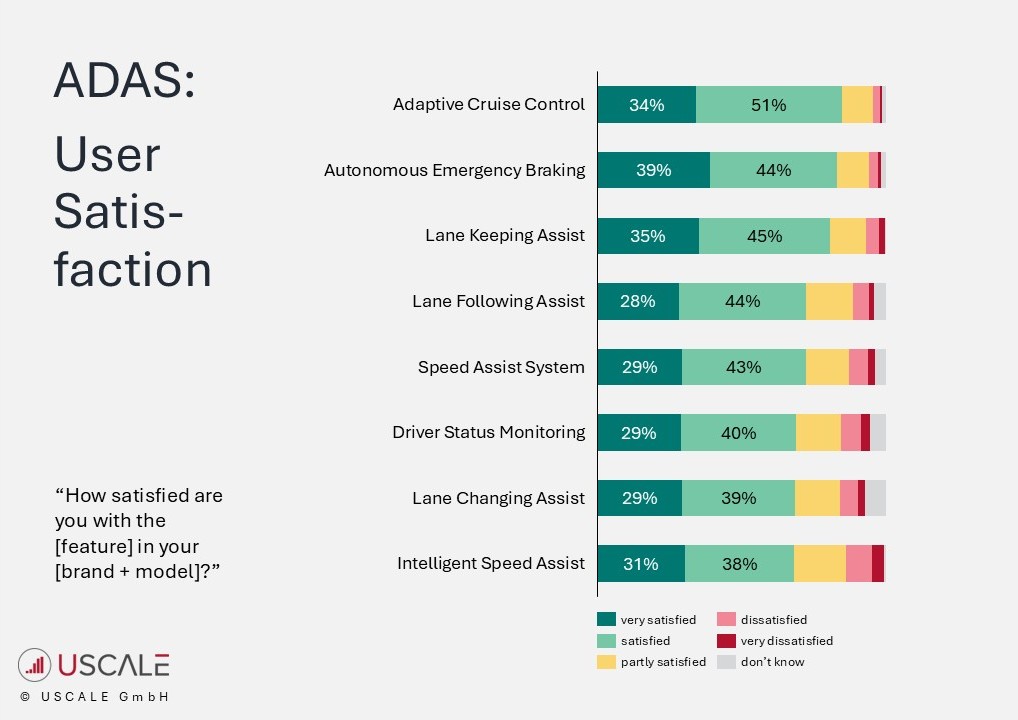
One thing is clear: the technology has arrived, acceptance has not. 81% of respondents are satisfied with the assistance systems overall, but only 35% are very satisfied.
Here are the main results of the ADAS Satisfaction Study 2026:
1. Known does not mean accepted
88% to 97% of drivers are aware of the mandatory systems. However, far fewer deliberately leave them switched on. Only 56% deliberately leave Intelligent Speed Assistance switched on, and 23% usually switch it off. 79% of them cite the warning sounds as the reason.
What does this mean for manufacturers?
A mandatory system that gets switched off misses its purpose. For each system and each brand, the study shows why drivers switch systems off and which concepts are accepted. Respondents’ more than [number] suggestions for improvement were evaluated using AI-assisted analysis and show very specifically where manufacturers can take action.
2. False alarms cost trust
With Autonomous Emergency Braking, every second dissatisfied user (51%) reports braking for no reason. With Driver Drowsiness and Attention Warning, 43% of dissatisfied users complain about warnings without any apparent cause. And with Speed Limit Assist, half of dissatisfied users cite incorrectly recognized traffic signs as a problem.
What does this mean for manufacturers?
Trust comes from reliability. The study shows in detail which malfunctions drivers experience, in which situations they occur and which brands already have the problems better under control.
3. Default settings make the difference
If Adaptive Cruise Control is activated by default, 69% leave it permanently switched on. If it is off by default, only 7% activate it as a rule. This pattern applies to all optional systems.
What does this mean for manufacturers?
The factory setting is a lever that costs almost nothing and has a massive impact on usage. The study shows how manufacturers preset their systems and which settings drivers accept.
4. Experienced EV drivers raise the bar
Among experienced EV drivers from the USCALE BEV panel, only 23% are very satisfied with the assistance systems overall, compared with 48% in the broad sample of the access panel. The gap runs through every system.
What does this mean for manufacturers?
Experienced users show where expectations are heading. Those who understand their criticism today can make targeted improvements to tomorrow’s systems.
5. Clear differences between brands
Whether a system is accepted depends heavily on its implementation. Accordingly, the differences between the twelve brands examined are considerable. The German premium manufacturers stand out in terms of maturity and enthusiasm, while the Korean brands and the volume brands of the Volkswagen Group are mostly in the midfield. Tesla presents a mixed picture: strong with its mandatory systems, weaker with its comfort features.
What does this mean for manufacturers?
Naturally, every decision maker looks at the performance of their own brand. But looking at the competition is just as important. Competitors often already offer functions or concepts that are still being discussed in-house. The study shows how they are received by customers. This allows managers and developers to learn from the competition. That saves time and a lot of money.
About the study
From May to July 2026, a total of 4,553 drivers in Germany were surveyed about the assistance systems in their vehicles first registered between 2023 and 2026. 2,228 respondents come from an access panel and represent the broad driver population. 2,325 experienced EV drivers were recruited via social media for the USCALE BEV panel. They pay particularly close attention to the details of a vehicle concept and are more critical of poorly thought-out solutions than the average customer. This makes their judgment particularly relevant for vehicle manufacturers.
→ More about the study
→ Contents of the study
Curious about the full results?
Then feel free to call me or send me an email! Or just book a meeting with me directly.
We support you with data, studies and insights from our representative surveys. Get in touch, we can help with our multi-client studies and custom studies.
We are looking forward to your inquiry.
Also have a look on an overview of our electric vehicle studies!
Contact us now
Which customer insights on electric cars, charging technology, or charging services are you looking for? Whatever you’re searching for, we look forward to exchanging ideas with you.
* mandatory