
Satisfaction up again, but big differences between brands
EV Satisfaction Study 2026: Satisfaction up again, but big differences between brands
EV drivers have never been more satisfied. But with every advance in the vehicles, expectations rise as well. What impressed three years ago is considered standard today. For manufacturers, this means that competition is increasingly shifting to topics that were long regarded as secondary.
As part of the EV Satisfaction Study, we surveyed around 4,000 EV drivers from Germany, Austria and Switzerland: What do electric cars deliver today? And where do users still see problems? Thanks to the large sample, the study provides differentiated insights. It allows assessments even of brands that are still young in Europe, such as BYD, Xpeng or Leapmotor, as well as detailed analyses of individual models from established manufacturers.
One thing is clear: satisfaction among drivers of fully battery electric vehicles continues to rise. The Net Promoter Score, a measure of willingness to recommend, rose from 33 to 38 points in the EV Satisfaction Study 2026. This is the highest value since the time series began.
Here are the main results of the EV Satisfaction Study 2026:
1. Vehicles are getting better, and expectations are rising with them
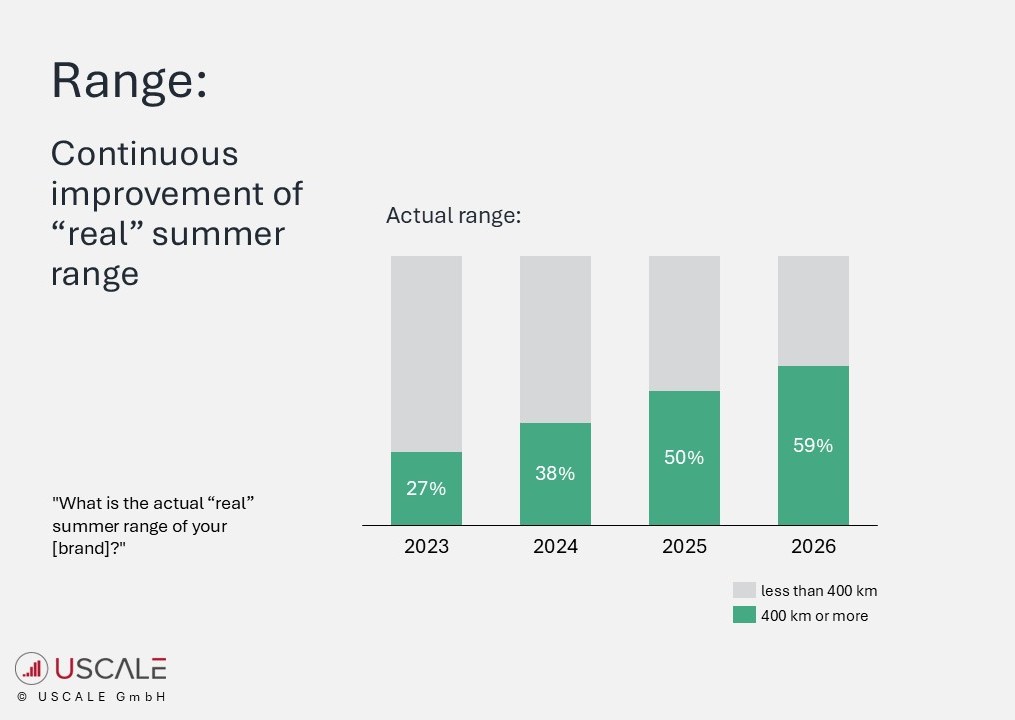
Manufacturers have continued to improve range and charging power. 59% of respondents now drive an EV with a real summer range of more than 400 kilometers (2025: 50%). At the same time, expectations are rising at the same pace. On average, the vehicles have therefore kept up with expectations. The result is higher overall satisfaction compared with the previous year.
What does this mean for manufacturers?
Expectations will continue to rise quickly. The study data and its more than 12,000 detailed verbatim comments show in great detail what matters and what customers particularly value, in short: where investments pay off and where failing to invest is quickly punished. This enables decision makers to make data-based decisions.
2. Range and charging speed: the benchmark is shifting
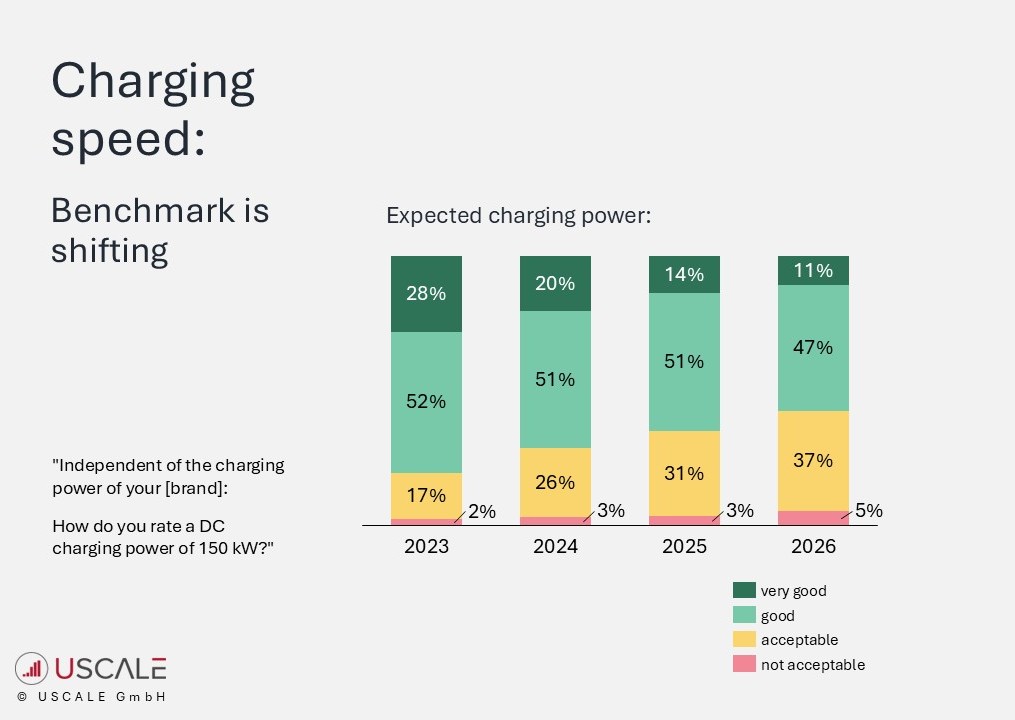
Only 75% still rate a “real” summer range of 400 km as (very) good (2025: 79%). The trend is even more pronounced for charging speed: while last year 65% of EV drivers rated a maximum charging power of 150 kW as (very) good, this year the figure is only 58%. The new benchmark is adding 200 kilometers of range in 15 minutes. 75% rate this performance as good or very good.
What does this mean for manufacturers?
Long range and high charging power cost a lot of money. Depending on the vehicle segment, the study shows how different ranges and charging powers are rated, in other words: where budgets are well invested.
3. Software and connectivity: the problem areas remain
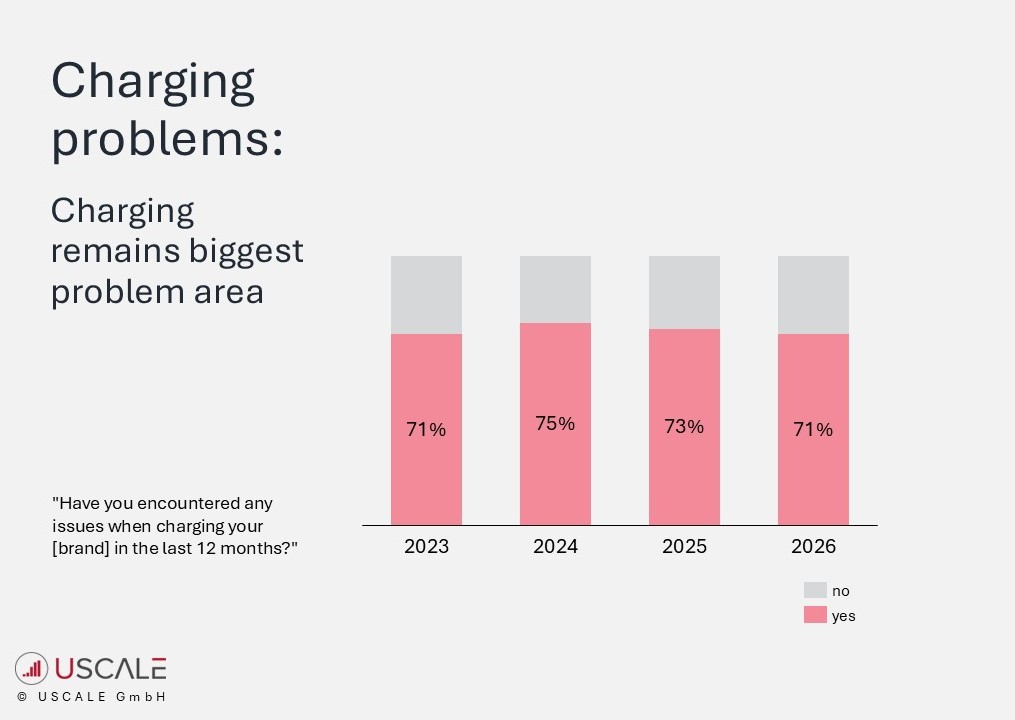
Charging remains the biggest source of problems in everyday use. 71% of respondents report problems with charging, most often because the charging process does not start or the charging power is unexpectedly low. Of all the concepts surveyed, support in the event of errors performs worst. Vehicle apps also continue to cause headaches: 48% of EV drivers report problems with their connect app. When asked where manufacturers should improve, software quality ranks first for the first time, ahead of charging power. It is also the topic that has deteriorated most compared with the previous year.
What does this mean for manufacturers?
In an electric car, software and the vehicle app are not an add-on but a central part of the vehicle. Providers need to know which functions matter. The study shows in detail which functions are used and how, what users expect and how the various solutions are rated.
4. New focus: warning sounds
Half of respondents are bothered by warning and notification sounds in the vehicle. The spread between brands is enormous, ranging from 29% to more than 80%. Warnings from driver assistance systems alone account for 30% of all reported problems.
What does this mean for manufacturers?
Warning sounds are a design choice, not a technical necessity. The study shows which sounds are perceived as annoying and which brands have already solved the issue well.
5. Deutliche Unterschiede bei den Marken
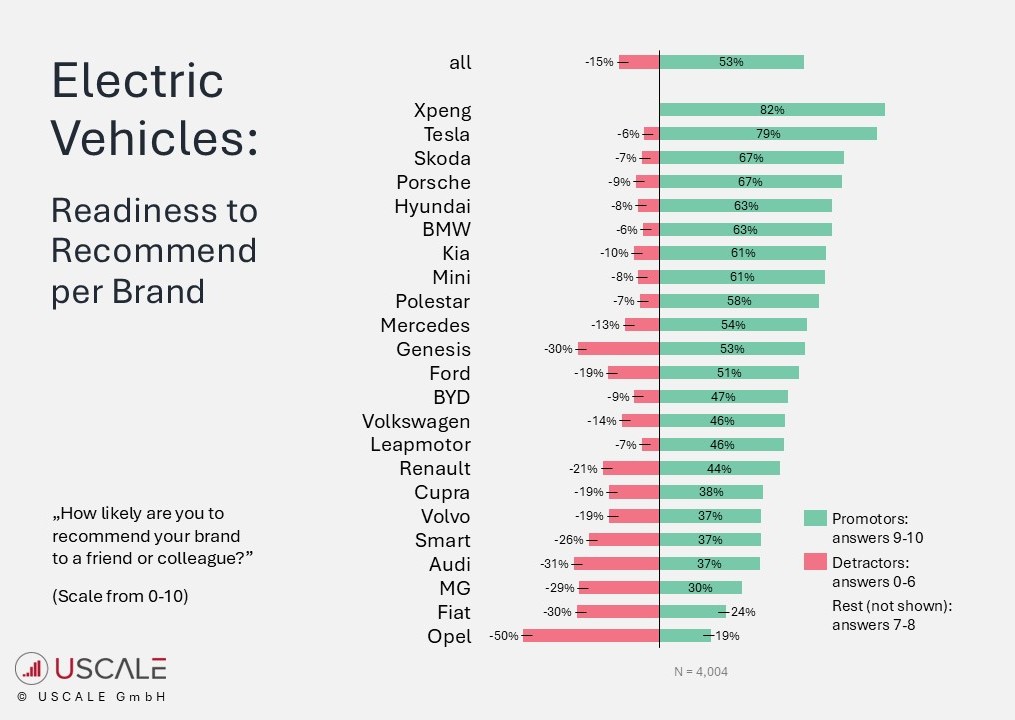
Willingness to recommend (measured with the Net Promoter Score, NPS) sums up the overall impression. The brands are drifting further and further apart: there are 113 points between the best and the worst score. Xpeng defends its top position, Tesla returns to second place, followed by Skoda and Porsche. At the other end of the ranking are once again brands from the Stellantis group, along with MG.
Respondents see major differences depending on the brand. In our press release, we describe the strengths and weaknesses of each brand.
What does this mean for manufacturers?
Naturally, every decision maker looks at the performance of their own brand. But looking at the competition is just as important. These brands often already offer features or concepts that are being hotly debated in-house. The study shows how they are received by customers. This allows managers and developers to learn from the competition. That saves time and a lot of money.
About the study
In June and July 2026, a total of 4,004 EV drivers from Germany, Austria and Switzerland were surveyed about their everyday experiences with their EVs, which were no more than three years old. Respondents were recruited via social media and are therefore not representative of the “average driver”. They pay closer attention to the details of a vehicle concept. They appreciate well-thought-out solutions more and criticize poorly thought-out ones more, than the average customer. Their judgment is therefore all the more relevant for vehicle manufacturers. The EV Satisfaction Study is part of the USCALE portfolio on the customer journey of e-mobility users and was conducted for the seventh time.
→ More about the study
→ Contents of the study
Curious about the full results?
Then feel free to call me or send me an email! Or just book a meeting with me directly.
We support you with data, studies and insights from our representative surveys. Get in touch, we can help with our multi-client studies and ad hoc studies.
We are looking forward to your inquiry.
Also have a look on an overview of our electric vehicle studies!
Contact us now
Which customer insights on electric cars, charging technology, or charging services are you looking for? Whatever you’re searching for, we look forward to exchanging ideas with you.
* mandatory