
Driver assistance systems are well known, but far from accepted

ADAS Satisfaction Study 2026: Driver assistance systems are well known, but far from accepted
Driver assistance systems have long been standard equipment in new cars, and since 2024 many of them have even been required by law. A recent survey of more than 4,500 drivers in Germany shows that almost everyone knows these systems. But false alarms and annoying warning sounds prevent drivers from actually trusting them.
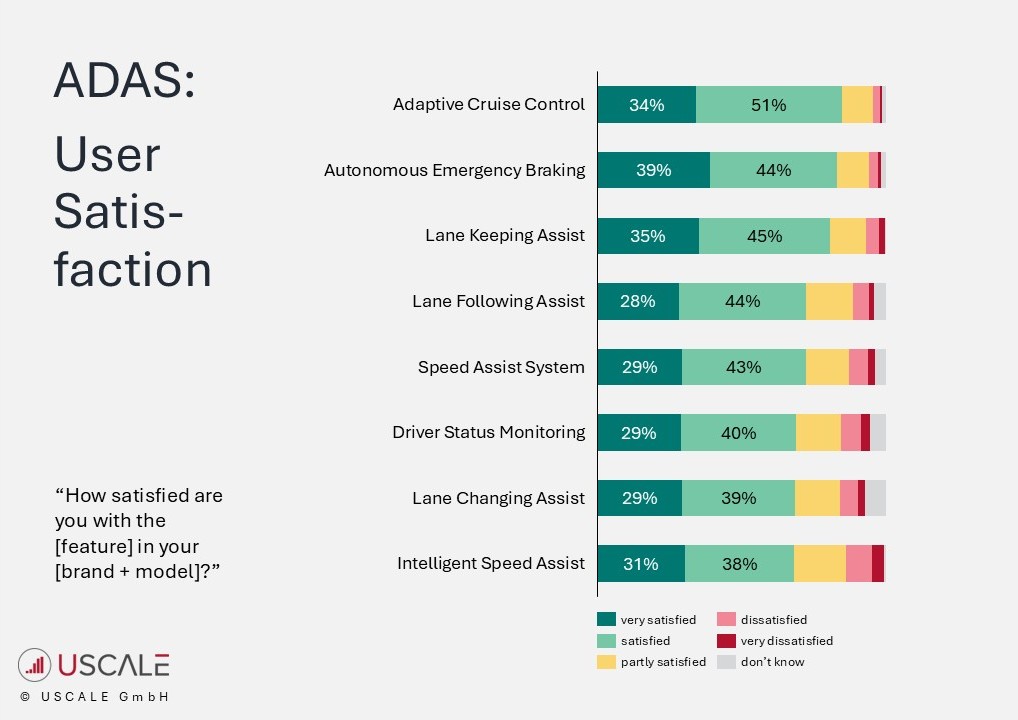
Stuttgart, November 17, 2026 – Advanced driver assistance systems (ADAS) are the foundation of automated driving. But whether a system actually helps in everyday driving is not decided in the lab but by the judgment of the drivers. The USCALE ADAS Satisfaction Study 2026 shows that the technology has arrived in the vehicles, but acceptance has not. While 81% of respondents are satisfied overall with the assistance systems in their car, only 35% are very satisfied. There are major differences between the individual systems: Adaptive Cruise Control performs best with 85% satisfied users, while Lane Change Assist and Intelligent Speed Assistance bring up the rear at 68% each.
Study approach: mandatory and optional assistance systems compared
The study approach is based on the EU General Safety Regulation, under which certain assistance systems must be fitted in all new cars since July 2024 and are automatically active every time the vehicle is started. The study therefore distinguishes between four mandatory systems (Lane Keeping Assist, Driver Drowsiness and Attention Warning, Autonomous Emergency Braking and Intelligent Speed Assistance) and four optional systems (Adaptive Cruise Control, Speed Limit Assist, Lane Following Assist and Lane Change Assist). The combined Driving Assist is also covered.
The central question is how the systems perform in everyday use: the study examines whether drivers know the systems, whether they consciously use them or switch them off, what role the default setting plays and how satisfied they are with individual aspects such as warning sounds, steering interventions or operation. Respondents’ open-ended suggestions for improvement were evaluated using AI-assisted analysis.
Known does not mean accepted
Drivers are largely aware of the mandatory systems: depending on the system, 88% to 97% know that it is active every time they start the car. However, far fewer deliberately leave the systems switched on because they want to use them. For Autonomous Emergency Braking the figure is 86%, for Lane Keeping Assist 71%. Respondents are particularly critical of Intelligent Speed Assistance, which warns when the speed limit is exceeded: only 56% deliberately leave it switched on, while 23% usually switch it off. 79% of those who switch it off cite the warning sounds as the main reason. As for Driver Drowsiness and Attention Warning, almost one in five only leaves the system on because they do not know how to switch it off.
False alarms cost trust
When systems intervene for no apparent reason, trust suffers. With Autonomous Emergency Braking, every second dissatisfied user (51%) reports braking for no reason. With Driver Drowsiness and Attention Warning, 43% of dissatisfied users complain about warnings without any apparent cause, and only 31% consider the system very well developed. And with Speed Limit Assist, which automatically adjusts the vehicle speed, half of dissatisfied users cite incorrectly recognized traffic signs as a problem. For each system, the study shows in detail which problems occur and what drivers would like instead.
Default settings determine usage
The factory setting is an underestimated lever. If Adaptive Cruise Control is activated by default, 69% leave it permanently switched on. If it is deactivated by default, only 7% activate it as a rule. The same pattern applies to all optional systems. At the same time, manufacturers differ considerably in how they preset their systems.
Experienced EV drivers raise the bar
The study compares a broad sample from an access panel with experienced EV drivers from the USCALE BEV panel. While 48% of the access panel are very satisfied with the assistance systems overall, only 23% of experienced EV drivers say the same. The gap runs through every single system and shows where expectations are heading.
Clear differences between brands
Whether a system is accepted depends heavily on how it is implemented. Accordingly, the differences between the twelve brands examined are considerable. The German premium manufacturers stand out: their systems are rated as more mature across almost all assistance systems, and their customers are more often very satisfied than average. The Korean brands and the volume brands of the Volkswagen Group, by contrast, are mostly in the midfield or slightly below. Tesla, often seen as a technology pioneer, presents a mixed picture: the brand impresses with its mandatory systems but is below average for comfort features such as Adaptive Cruise Control. The study provides a detailed profile of strengths and weaknesses for each brand.
About the study
From May to July 2026, USCALE surveyed a total of 4,553 drivers in Germany about their awareness, use of and satisfaction with driver assistance systems. Respondents drive battery electric, plug-in hybrid and combustion engine vehicles first registered between 2023 and 2026 (excluding city cars and mini SUVs). 2,228 respondents come from an access panel and 2,325 from the USCALE social media panel of experienced EV drivers. Participants only rated systems that are fitted in their own vehicle.
The study covers awareness, usage and reasons for switching systems off, satisfaction, perceived maturity, problems and recommendations to the development departments of the automotive and supplier industry. Detailed results are available for the brands Audi, BMW, Cupra, Ford, Hyundai, Kia, Mercedes, Renault, Skoda, Tesla, Volkswagen and Volvo. USCALE offers the study to all interested companies in the form of study licenses.
Quote
Dr Axel Sprenger, founder and managing director of USCALE GmbH:
“Assistance systems have arrived in cars, but not yet in drivers’ minds. When systems are switched off because they are annoying or intervene for no reason, that is not only a technology problem but also a trust problem. One thing is clear: there is still a lot to do.”
More information on the study:
Further informationen on this study
List of all study content
About USCALE
USCALE is a market research company specializing in electric mobility, based in Stuttgart. The company supports manufacturers, infrastructure and charging service providers with data-driven market research and strategic consulting.
contact
USCALE GmbH, Silberburgstrasse 112, D – 70176 Stuttgart, +49 711 620014-0, media@uscale.digital