
Satisfaction up again, but big differences between brands

EV Satisfaction Study 2026: Satisfaction up again, but big differences between brands
Satisfaction with electric vehicles has reached a new high. A recent survey of around 4,000 EV drivers in Germany, Austria and Switzerland shows that range and charging power continue to improve. At the same time, expectations are growing too. Not all brands can keep up.
Stuttgart, October 20, 2026 – Satisfaction among drivers of fully electric vehicles has risen for the third year in a row. The Net Promoter Score (NPS), a measure of willingness to recommend, rose from 33 to 38 points year on year in the current USCALE EV Satisfaction Study 2026. This is the highest value since the time series began. Across all brands, 53% of respondents would actively recommend their vehicle (see press handout), 15% would advise against it and the remaining 32% are neutral.
Vehicles are getting better, and expectations are rising with them
Manufacturers continue to make progress on range and charging power. 59% of vehicle owners now report a real summer range of more than 400 kilometers (2025: 50%). 77% of EVs offer a DC charging power of 150 kW or more (2025: 75%). At the same time, expectations are rising. Only 75% still rate a summer range of 400 kilometers as good or very good (2025: 79%), and only 15% still consider it very good. In 2023, twice as many did. The trend is even more pronounced for charging: only 58% still rate a charging power of 150 kW as good or very good (2025: 65%).
Charging remains the biggest problem area
Despite all the technical progress, charging remains the biggest pain point in everyday use. 71% of respondents report problems with charging (2025: 73%). The most frequently cited issues are difficulties starting the charging process and unexpectedly low charging power. The charging station search in the navigation system also performs poorly: only 43% consider the concept well implemented, while 56% see room for improvement.
Software and connectivity: still the problem children
Even with the much-criticized car software, there is still no breakthrough. 48% of EV drivers report problems with their connect app (2025: 50%). The differences between brands are enormous: only 8% of Tesla drivers report app problems, compared with 92% of Opel drivers. When asked where manufacturers should improve, software quality ranks first at 44%, ahead of charging power (42%), the connect app (39%), route planning (35%) and range (34%). While range, consumption and charging power have improved compared with the previous year, software quality is criticized even more often than in 2025.
Warning sounds annoy half of all drivers
Warning and notification sounds in the vehicle are a new source of irritation. Half of respondents are bothered by them. The spread between brands shows that this is a design choice rather than a technical necessity: only 29% of Mini drivers feel bothered, compared with around 80% of Kia and Hyundai drivers. Warnings from driver assistance systems alone bother 30% of all respondents.
Considerable differences between brands
Willingness to recommend varies widely from brand to brand. XPENG defends its top position. Tesla returns to second place after finishing sixth last year, followed by Skoda and Porsche. Once again, Stellantis brands Opel and Fiat are at the bottom of the ranking, together with MG. The Chinese brands present a mixed picture: XPENG leads, BYD and newcomer Leapmotor land in the midfield, while Smart and MG disappoint.
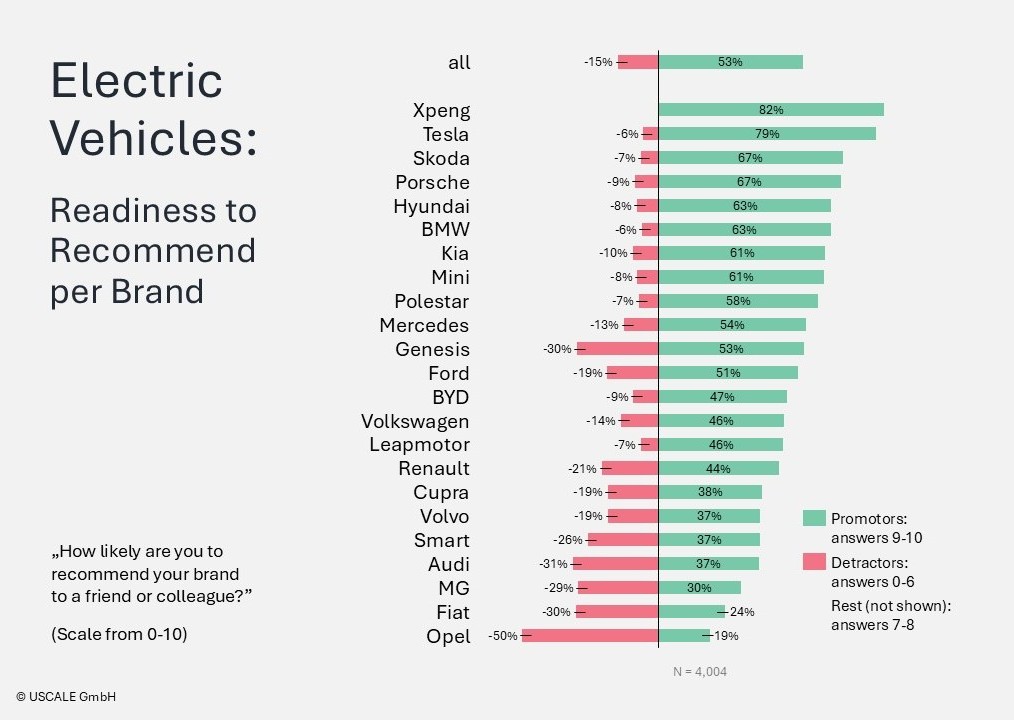
Strengths and weaknesses of brands:
- XPENG is well above average in almost all categories. Customers are particularly impressed by charging power, charging management and range. The connect app has improved massively compared with the previous year. Route planning remains the biggest weakness, and consumption is also criticized more often than in 2025.
- Tesla returns to second place and impresses in almost all EV-specific disciplines, above all software, connect app, route planning and consumption. Charging power remains a weak point, criticized by more than every second Tesla driver. Criticism of acoustics and build quality adds to this, although it has eased. Many further requests for improvement concern the driver assistance systems.
- Skoda climbs to third place. Compared with the Enyaq, the Elroq improves in almost all areas. Drivers still see a need for action in route planning and software quality.
- Porsche continues to impress with outstanding charging power and high build quality. Software quality and route planning are rated below average.
- Hyundai impresses with long range and high charging power and improves in almost all areas.
- BMW scores with software, connect app, route planning and charging management. The “Neue Klasse”, on the market since mid-2026, is not yet included in the study.
- Kia scores with good range and significantly improved software quality. Route planning, however, remains a weak point.
- Polestar continues to impress with its operating concept, route planning and connect app. Customers see a need for action on consumption, software quality and noise insulation.
- Mercedes makes a big leap in range, consumption and charging power thanks to the new MMA platform with the CLA and GLB. The connect app is rated above average. However, software and build quality are criticized more often than in the previous year, especially for the new models.
- Ford benefits from the Explorer, which outperforms the Mustang Mach-E in most disciplines. The brand has improved significantly in consumption compared with the previous year. The connect app remains a major weakness, and charging power is also criticized.
- BYD users credit the brand with convincing software, connect app and route planning. Although charging power has improved, drivers still see a great need for action here, as well as in consumption and usability.
- Volkswagen is below average overall. The ID.7 impresses with better range, lower consumption and higher charging power than the ID.3, ID.4 and ID.5. Software and the connect app, however, remain the brand’s major problem areas.
- Leapmotor appears in the ranking for the first time and starts in the midfield. Customers praise range and the connect app. They see a clear need for improvement in the operating concept and route planning.
- Renault impresses with route planning and software. Low charging power and problems with the connect app weigh on the brand.
- Cupra remains below average. Despite improvements in the connect app, the brand continues to struggle with app and software problems, and charging power is also criticized.
- Volvo scores with its Google-based route planning. Consumption has improved compared with the previous year but, together with range and software, remains the main point of criticism.
- Smart impresses with charging power, range and charging management. Drivers see a clear need for improvement in consumption, route planning, software, usability and the app.
- Audi has improved significantly in range and charging power with the A6/Q6 e-tron. At the same time, software is criticized even more often than in the previous year. The connect app and vehicle quality also remain well below expectations.
- MG impresses with range and equipment but shows clear weaknesses in software and the connect app.
- Fiat continues to score with low consumption. Major problems arise in range, charging management and the connect app.
- Opel is once again at the bottom of the ranking. 92% of Opel drivers report problems with the connect app. On top of that come massive weaknesses in charging management, software and usability.
About the study
In June and July 2026, a total of 4,004 EV drivers from Germany, Austria and Switzerland were surveyed about their everyday experiences with their EVs, which were no more than three years old. Respondents were recruited via social media and are therefore not representative of the “average driver”. They pay closer attention to the details of a vehicle concept. They appreciate well-thought-out solutions more, and criticize poorly thought-out ones more, than the average customer. Their judgment is therefore all the more relevant for vehicle manufacturers. The EV Satisfaction Study is part of the USCALE portfolio on the customer journey of e-mobility users and was conducted for the seventh time.
Quote
Dr Axel Sprenger, founder and managing director of USCALE GmbH:
“EV drivers have never been more satisfied. But they are also becoming increasingly demanding. What was exciting yesterday is standard today. Manufacturers have done their homework on range and charging. Now competition will be decided by software, connectivity and a seamless charging experience. Those who fail to deliver here will fall behind, and the ranking clearly shows this.”
More information on the study:
PRESS HANDOUT with additional charts
Further informationen on this study
List of all study content
About USCALE
USCALE is a market research company specializing in electric mobility, based in Stuttgart. The company supports manufacturers, infrastructure and charging service providers with data-driven market research and strategic consulting.
contact
USCALE GmbH, Silberburgstrasse 112, D – 70176 Stuttgart, +49 711 620014-0, media@uscale.digital