
The Fleet Charging Study 2026 shows: fleets are on the move. Measured, but determined. For providers who make the right moves now, long-term customer relationships are there for the taking.
Fleet Charging Study 2026: Commercial fleets on the road to electrification
IAA TRANSPORTATION 2026 is just around the corner, and at Power2Drive 2026 in Munich, truck charging was a topic at every other booth.
For most fleets, the question is no longer whether to electrify, but how to go about it smartly.
That was reason enough for us to launch a Fleet Charging Study 2026. We’ve completely redesigned the study and doubled the sample size to 1,213 participants, giving us a much sharper picture of how the market works and what actually matters.
Among the questions we looked at:
- Who is electrifying, and how? What matters most to different industries and companies?
- What charging solutions are fleets looking for at the depot? How do companies make their decisions?
- What does the purchase funnel look like?
- How do charging management and fleet management systems work together?
- Which providers are leading in public charging? What criteria drive the decision?
Here are some selected important findings of the Fleet Charging Study 2026:
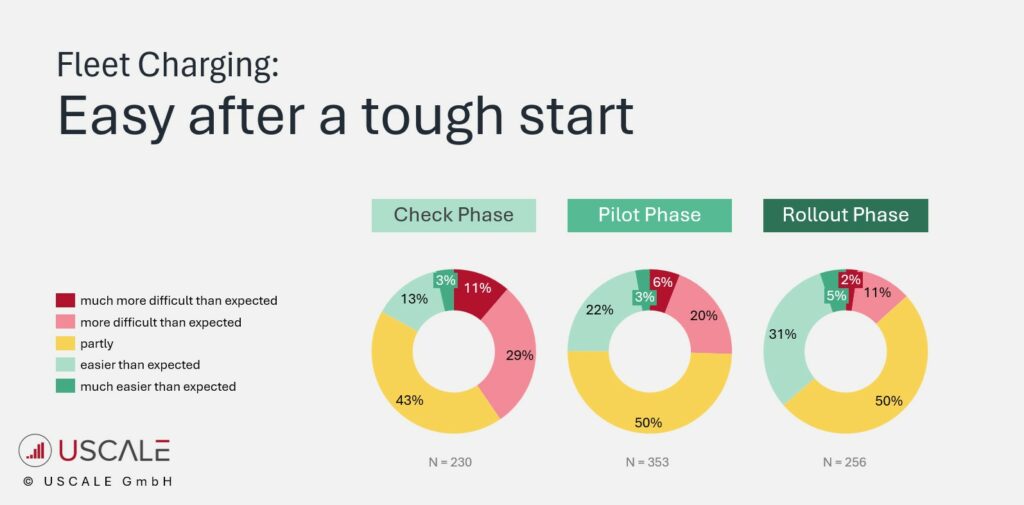
Fleet electrification: the picture flips after the pilot phase
Companies that are just starting out tend to find electrification harder than expected. Those who’ve made it through the first phase take a much more relaxed view.
What does this mean for providers?
The first phase is critical. The study shows in detail where providers can build trust and establish a long-term position.
Fleet charging management moves to center stage
In 2024, the fleet management system (FMS) was the natural anchor point. Now, as electrification matures, charging management software (CMS) is gaining ground.
What surprised me was how many companies are now open to more than just connecting the two systems via interfaces. CMS providers have a real shot at taking over significant parts of the FMS. It doesn’t take much imagination to see where that could lead.
What does this mean for providers?
Charging management systems are becoming core infrastructure. System integration is turning into a key differentiator. The study shows which integration scenarios work, what data is actually needed day-to-day, and where providers still have gaps.
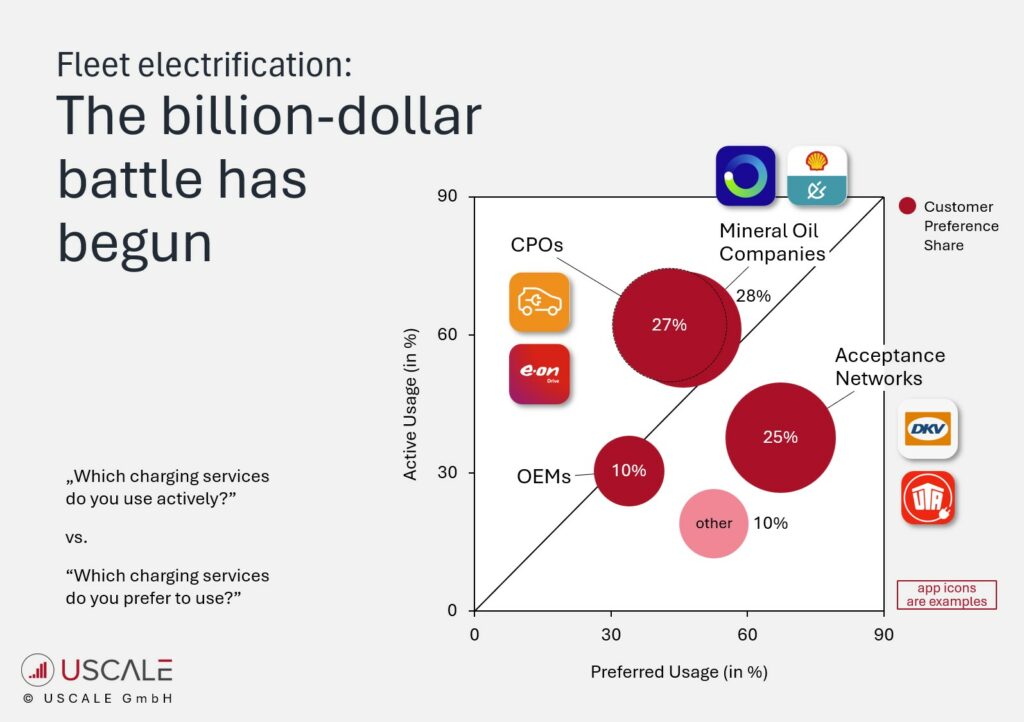
The market for fleet on-the-road charging is wide open
Acceptance networks, oil companies, and CPOs are all running close in fleet preference. Price and network coverage dominate, but system integration is a growing factor. Whoever delivers faster wins.
Our study looks at the profiles of the major providers and provider groups. I was genuinely surprised by how distinct the profiles are.
What does this mean for providers?
Today’s providers are reaching very different target groups. The study maps out who’s reaching whom and where the untapped potential lies.
Fleet archetypes for electrification
The data from this study is extensive, and we’re not done yet. Over the coming weeks, we’ll be developing what we call company archetypes for fleet electrification.
What does this mean for providers?
The variety of situations providers encounter on the customer side is vast. Market segmentation is the only way to bring order to that complexity. It helps providers translate their solutions into clear, compelling packages tailored to each archetype.
What’s next? Who’s going to win?
There’s a lot to do, and that’s a good thing. Fleets are committed to electrification. Most have strategic goals but approach execution with the right balance of ambition and risk awareness.
Fleet electrification is a marathon. That’s exactly why getting it right from the start matters so much.
The most important purchase criterion for companies is scalability. Get a foot in the door and you’re looking at a long customer relationship. Understanding what matters from day one is therefore crucial. The Fleet Charging Study provides exactly that: data-driven, hands-on, with a clear view of the fleet perspective.
About the study
The Fleet Charging Study 2026 is based on 1,213 fleet decision-makers surveyed in Germany in April 2026. 873 are actively working on electrifying their fleets; 340 are not yet. The study covers electrification goals and barriers, depot and on-the-road charging infrastructure, provider selection and system integration, and the perspective of e-truck drivers. USCALE was supported by eTrucker (www.etrucker.io) in developing the questionnaire and recruiting e-truck drivers.
Full results are available under license, including team presentations and additional analyses on request.
More information:
- Details on the Fleet Charging Study
- Overview of study contents and a sample excerpt.
Your benefit from the study
If you’d like to understand how to successfully develop and market your fleet charging offering, do get in touch. In 20 minutes, I’ll show you which insights are particularly relevant to you.
USCALE supports you with data, studies, and insights – as a multi-client study or a tailored ad-hoc study for your specific questions.
Feel free to also take a look at the overview of our multi‑client charging studies!
Contact us now
Which customer insights on electric cars, charging technology, or charging services are you looking for? Whatever you’re searching for, we look forward to exchanging ideas with you.
* mandatory