
The USCALE Charging Services Study 2025 reveals how the balance of power between CPOs and eMSPs in the UK is shifting. It shows why providers now need a sharp value proposition, a focused target‑group strategy and a well‑defined competitive playbook.
EV Charging Services Study 2025: Competitive strategies for CPOs in the UK
In the UK, a strongly CPO‑centric and highly competitive market developed early on. It was driven by private investment, national funding programmes and the early entry of large energy and oil companies.
Unlike Germany or France, there are no dominant municipal networks or a central roaming platform. Instead, integrated CPO brands control infrastructure, software and the end‑customer relationship in one hand.
Regulatory interventions and consumer experience requirements have primarily strengthened competition at the infrastructure level and favoured CPOs with their own, visible brand. Pure roaming eMSPs never became central gatekeepers in this environment, but instead remained an add‑on to strong CPO networks.
From infrastructure build‑out to customer demand and loyalty
For years, the public debate focused on the number of charge points, installed capacity and network expansion. Public charging has scaled up successfully. The focus is now shifting from the supply side (“Are there enough charge points?”) to the demand side (“Who is charging where and why?”). We explore this general shift in more detail in a separate blog post on the USCALE website.
According to Zapmap’s 2025 EV charging statistics, public charging infrastructure in the UK grew by around 19% in 2025, with the strongest growth in high‑power charging. Growth is particularly strong in London and the South East. As a result, significant regional disparities in access to public charging remain. Despite this, the market as a whole is now moving from scarcity to competition.
The USCALE Charging Services Study 2025 provides the relevant demand‑side data: in November 2025, we surveyed 550 EV drivers in the UK who use public charging. The key customer KPI for CPOs is the Customer Preference Share. It shows which providers are leading and which are being left behind, why drivers prefer certain services, and how CPOs and eMSPs can strengthen their market position.
Background:
Customer preference share, the key KPIs for CPO success
For a provider to be successful, two levers are relevant:
- Active use: EV drivers must know the charging offer and find it attractive enough to use it. In our charging services studies we therefore ask EV drivers which charging services they actively use. Usually people use around three per person.
- Preferred use: If a charging offer is used at all, it must be convincing enough that EV drivers prefer it. In our charging services studies we capture which of the actively used services they favor and under what circumstances the others are used.
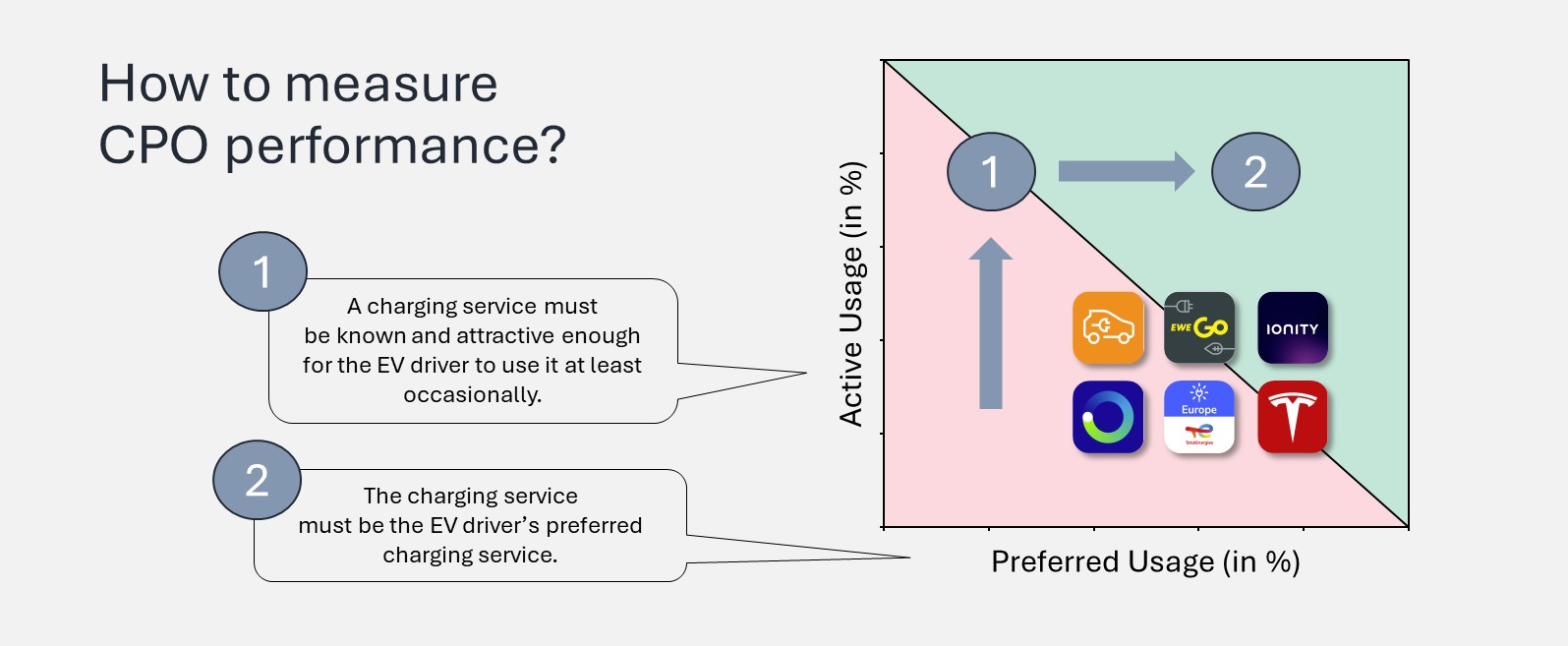
calculating customer preference shares from active and preferred usage
The USCALE CPO / eMSP Charging Service Study measures the customer preference share and analyzes the reasons for customer loyalty and disloyalty. The Charging Preference Matrix describes an operator’s preference share in the overall market and is calculated from the active and preferred usage of each provider.
Active Usage, Preferred Usage and Customer Preference Share in the UK
The early market development still shapes the UK today. With their focus on high‑power charging along major corridors, pure CPOs such as Tesla, InstaVolt and IONITY occupy pole position: 78% of public‑charging EV drivers have a contract with a CPO, and 59% of them prefer their CPO which leads to a customer preference share of 46%.
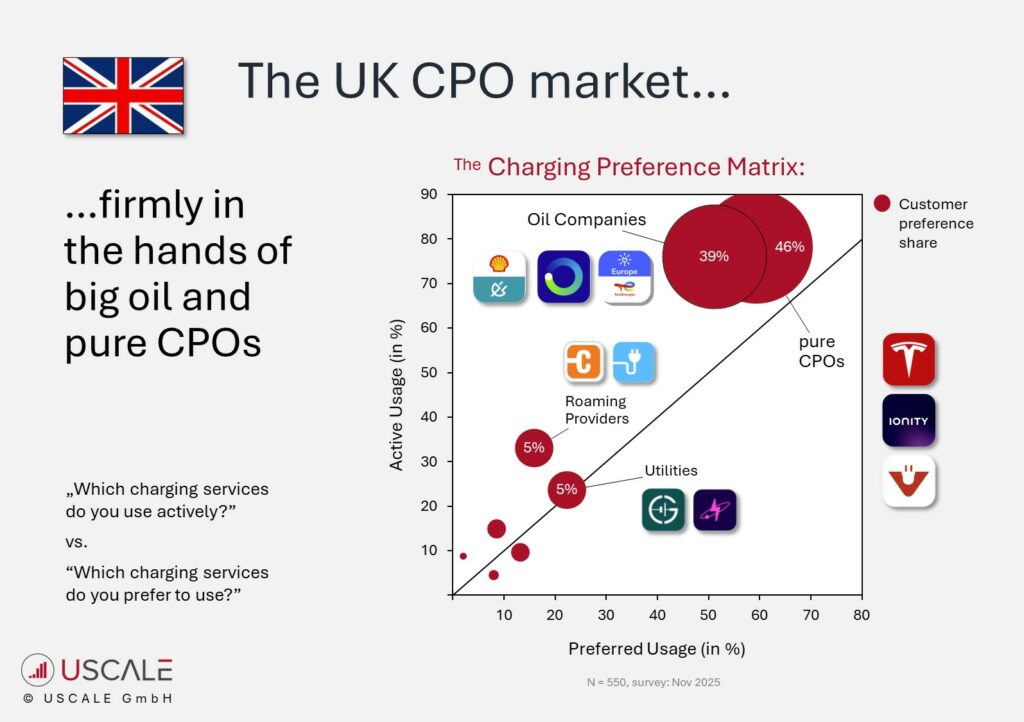
Large oil companies such as Shell, BP and TotalEnergies form a second major cluster. They are expanding their service‑station networks with high‑power chargers and are gaining further ground. 76% of drivers use a charging service from an oil company. 51% of them do so preferentially, resulting in a customer preference share of 39%.
Classic roaming providers are losing relevance and, together with utilities and other players, remain in shrinking niches. For CPOs, this means that differentiation is less about sheer access and more about location quality, charging performance, brand strength and a consistent digital service experience.
Trends in the UK CPO market
When breaking down the charging preference matrix by the date of purchase of the electric vehicle – that is, when respondents owned their first EV – clear trends emerge. Above all, Big Oil gains significantly among new adopters, while other provider groups lose ground as EV adoption progresses.
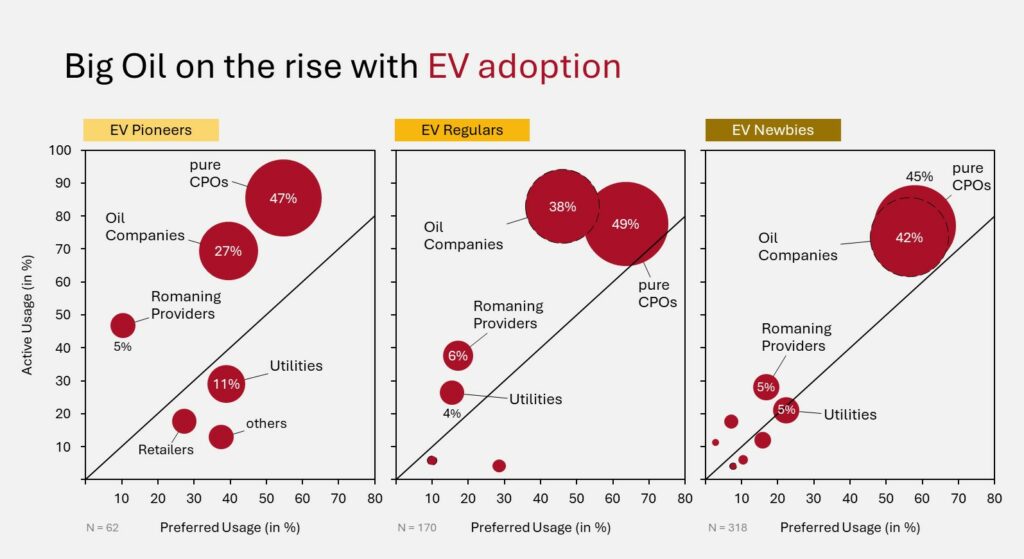
CPOs and eMSPs therefore need to monitor their own Customer Preference Share over time, in particular across different adopter cohorts. Established players must track active and preferred use continuously to understand and improve customer loyalty. New entrants need to understand existing market structures, path dependencies and dominance patterns to design their proposition and target segments accordingly. This includes pricing, roaming strategy, partnerships and core marketing messages.
From market understanding to customer understanding
Understanding the UK public charging market is only the first step. The next step is understanding your customers. For providers who want to further develop their charging service, this means knowing which customer segments actually use their offer today, which groups they want to win in the future, and how each new wave of EV adopters reshapes the market structure.
Key tasks include:
- Segment customers: which user groups charge where and why, and which charging profiles and personas are relevant?
- Define brand positioning: develop a clear strategy and identify priority target groups.
- Derive USPs and core messages for marketing, product management and business development.
In a dynamic market like the UK, where infrastructure, provider landscape and policy keep evolving, each new customer segment changes the playing field.
About the CPO / eMSP Charging Services Study 2025
The USCALE Charging Services Study 2025 highlights the strengths, weaknesses and opportunities of different providers: from market shares and the impact of performance features and pricing on take‑rate through to brand perception. For CPOs and eMSPs, it provides an essential basis to review and sharpen their strategic positioning and secure competitive advantage.
Key questions the study helps answer include:
- How can I differentiate beyond price?
- Which target groups am I reaching – and how?
- How can I strengthen my brand in an increasingly saturated market?
- How can I increase utilisation at my charge points?
One thing is clear:
EV charging is moving from an infrastructure question to a brand question. Providers who actively shape this shift will secure a decisive edge.
Your benefit from the study
The USCALE CPO/eMSP Charging Services Study for France shows you
- where your brand stands on the demand side,
- how high your customer preference share is in relevant customer segments, and
- what untapped potential exists in markets and target groups.
If you would like to understand how the French charging market works, why EV drivers in France charge exactly where they do today, and how you can systematically shift Active Use, Preferred Use, and loyalty in your favor, please get in touch with us.
Feel free to also take a look at the overview of our multi‑client charging studies!
Contact us now
Which customer insights on electric cars, charging technology, or charging services are you looking for? Whatever you’re searching for, we look forward to exchanging ideas with you.
* mandatory