
The USCALE Charging Services Study 2025 shows how competition between CPOs and eMSPs in France is changing. Providers are encouraged to position themselves strategically through a clear value proposition, a target-group-specific approach, and a tailored competitive strategy.
EV Charging Services Study 2025: Competitive strategies for CPOs and eMSPs in France
Every European market for public charging operates differently, and France is an extreme case. In France, regulation early on promoted many regional and municipal CPO networks as well as roaming via GIREVE. As a result, a highly fragmented, roaming‑heavy market emerged. Now, with the “Charge France” initiative, a second wave of well‑capitalized fast‑charging CPOs is sweeping across the country, and the market and competitive landscape are changing significantly.
The focus is shifting from supply to demand: customer acceptance and customer retention are decisive
In recent years, the focus has been on the number of AC and DC charging points, installed power, and grid expansion. With the successful build‑out of public charging infrastructure, the emphasis is now shifting from the supply side (“Are there enough charging points?”) to the demand side (“Who is charging where – and why?”). We describe this shift in detail in a separate blog post on the USCALE website.
It is clear: competition is becoming tougher and customer loyalty is turning into a central factor. Providers must adapt to a new playing field, shifting away from pure infrastructure toward brand strength and user preference.
The USCALE Charging Services Study 2025 provides the key data for this: more than 500 EV drivers who actually use public charging in France were surveyed about their real charging behavior. The findings show that the central customer KPI for CPOs is the customer preference share. It indicates who is leading and who is on the sidelines, reveals the reasons behind user preferences, and shows how you as a CPO or eMSP can strengthen your market position.
Background:
Customer preference share, the key KPIs for CPO success
For a provider to be successful, two levers are relevant:
- Active use: EV drivers must know the charging offer and find it attractive enough to use it. In our charging services studies we therefore ask EV drivers which charging services they actively use. Usually people use around three per person.
- Preferred use: If a charging offer is used at all, it must be convincing enough that EV drivers prefer it. In our charging services studies we capture which of the actively used services they favor and under what circumstances the others are used.
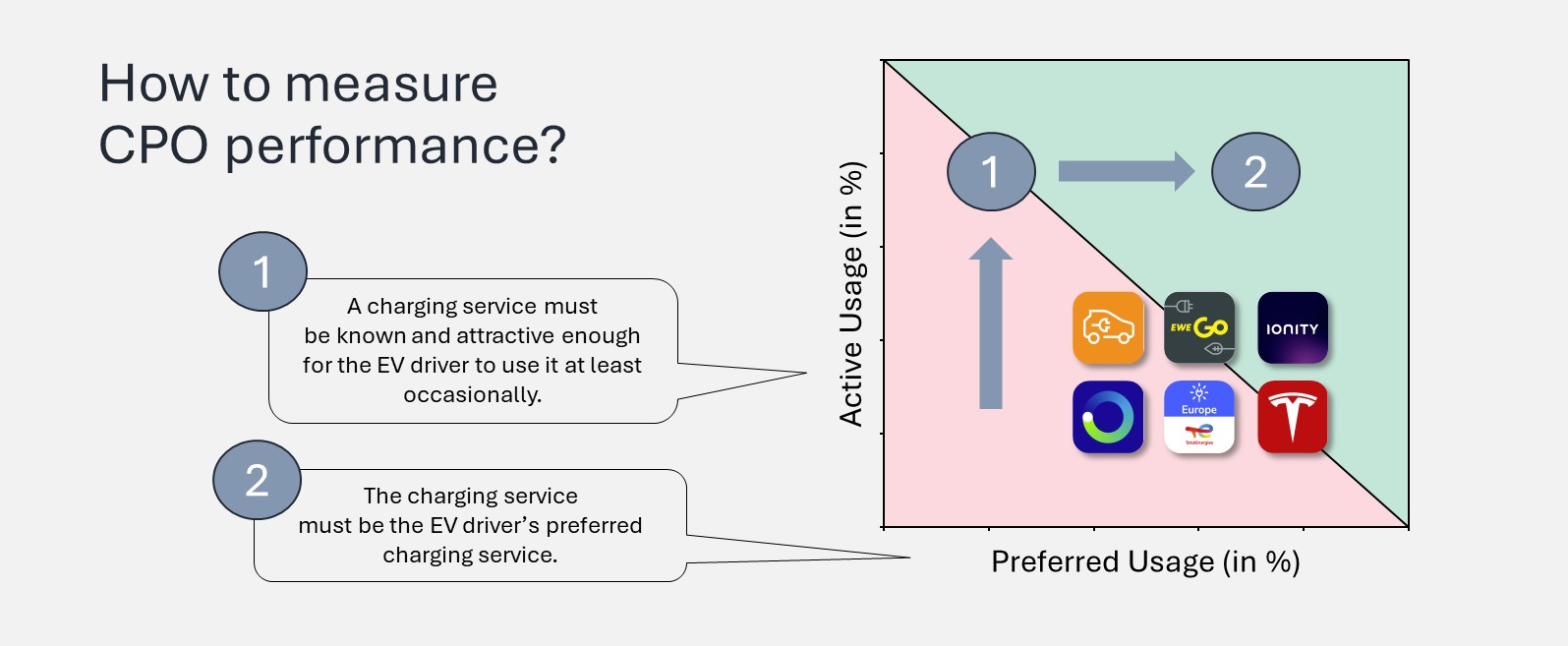
calculating customer preference shares from active and preferred usage
The USCALE CPO / eMSP Charging Service Study measures the customer preference share and analyzes the reasons for customer loyalty and disloyalty. The Charging Preference Matrix describes an operator’s preference share in the overall market and is calculated from the active and preferred usage of each provider.
What makes the French EV charging market special
Historically, France’s public charging infrastructure market first developed into a highly fragmented landscape through municipal and regional initiatives. In this environment, specialized players such as Chargemap took on a central role, providing orientation and access to many small networks through charging cards, service offers, and roaming solutions. At the same time, large energy and oil companies like TotalEnergies began investing heavily in public charging infrastructure and positioning themselves as independent CPO brands. In recent years, the trend has become clear: traditional roaming intermediaries like Chargemap are losing relative importance, while “Big Oil” players and pure‑play CPOs with their own networks and strong brands are gaining visibility and direct customer access.
France today belongs to the countries with the densest public charging infrastructure in Europe. Over 100,000 public charging points are available, and almost all highway rest areas are now equipped with charging offers. The original question of scarcity has therefore largely been resolved. Customers can now choose, and these very choice options are reflected in our KPIs for Active and Preferred Use.
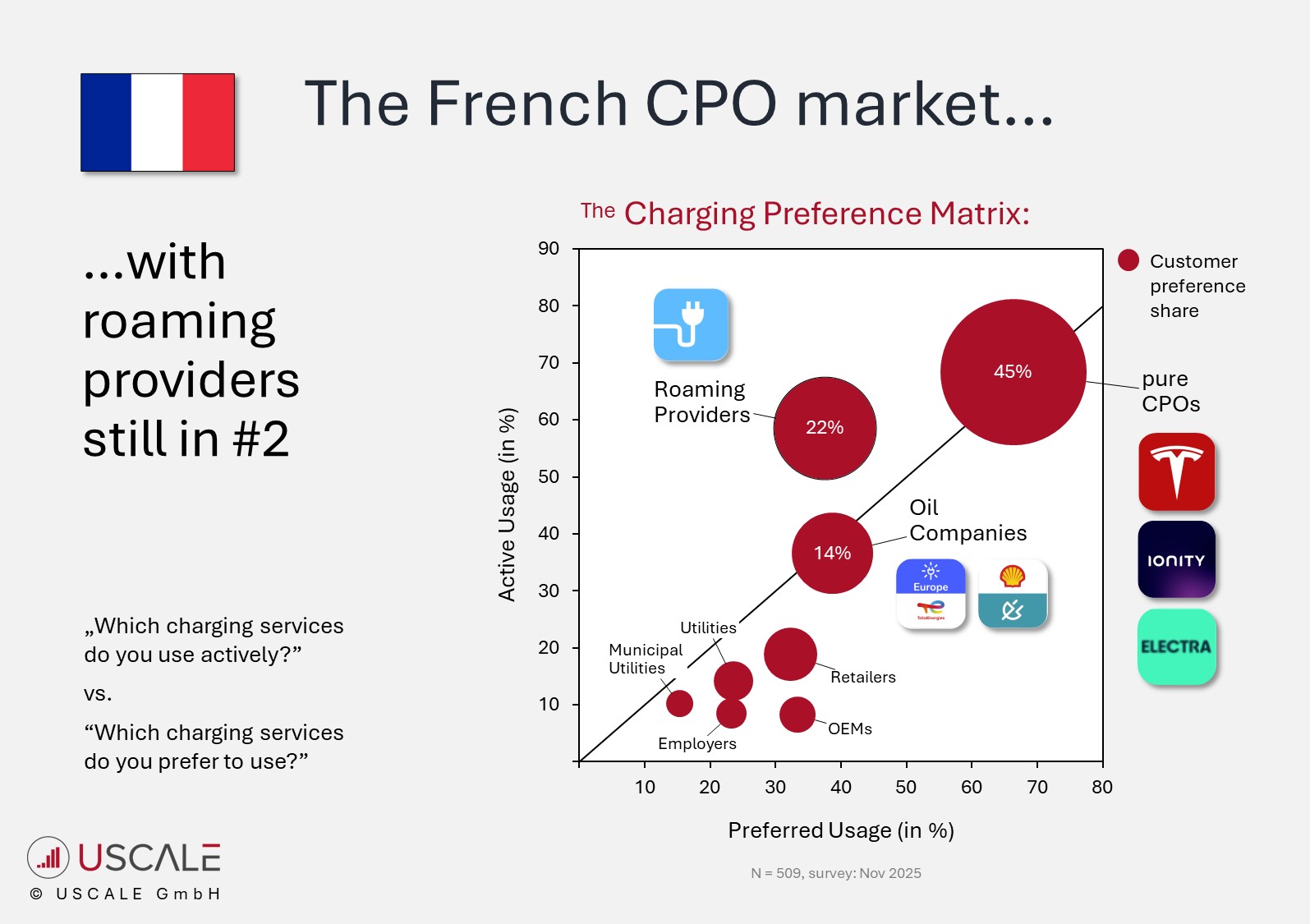
Active use, preferred use and customer preference share in France
The USCALE CPO Performance Portfolio shows which charging services EV drivers in France actually use, which ones they prefer, and which ones remain “sidelined”.
Pure CPOs in France are used actively by almost 70% of EV drivers. Of these, around 70% also prefer a pure CPO as their main choice. This results in a customer preference share of 49% on the French market. Roaming providers (led by ChargeMap) rank second with a customer preference share of 22%. Oil majors come in third with around 14%. The USCALE study breaks down, for all major providers, their share within individual segments as well as in the overall market.
CPOs and eMSPs to monitor their own customer preference share in a market
Established players must continuously monitor their active and preferred usage to understand and systematically improve customer loyalty. Active use, preferred use, and customer preference share are the key KPIs, complemented by the analysis of preference drivers and brand perception.
New entrants need to understand existing market structures, path dependencies, and dominance relationships in order to design their product appropriately and position it with the right target groups. This includes pricing structure, roaming strategies, the design of partnerships, core marketing messages, and more.
From market understanding to customer understanding
Understanding the French market is only the first step. The next is customer understanding. Concretely, this means: whoever wants to further develop their charging service must know which customer segments currently use their offering, which groups they want to win in the future, and how each new customer segment also changes the market structure.
This includes:
- Segmenting customers: Which user groups charge where today and why? Which charging profiles and charging personas are important?
- Defining brand positioning: developing a clear strategy and identifying target groups.
- Deriving USPs and core messages for marketing, product management, and business development.
An example: changing customer structures during the ramp‑up
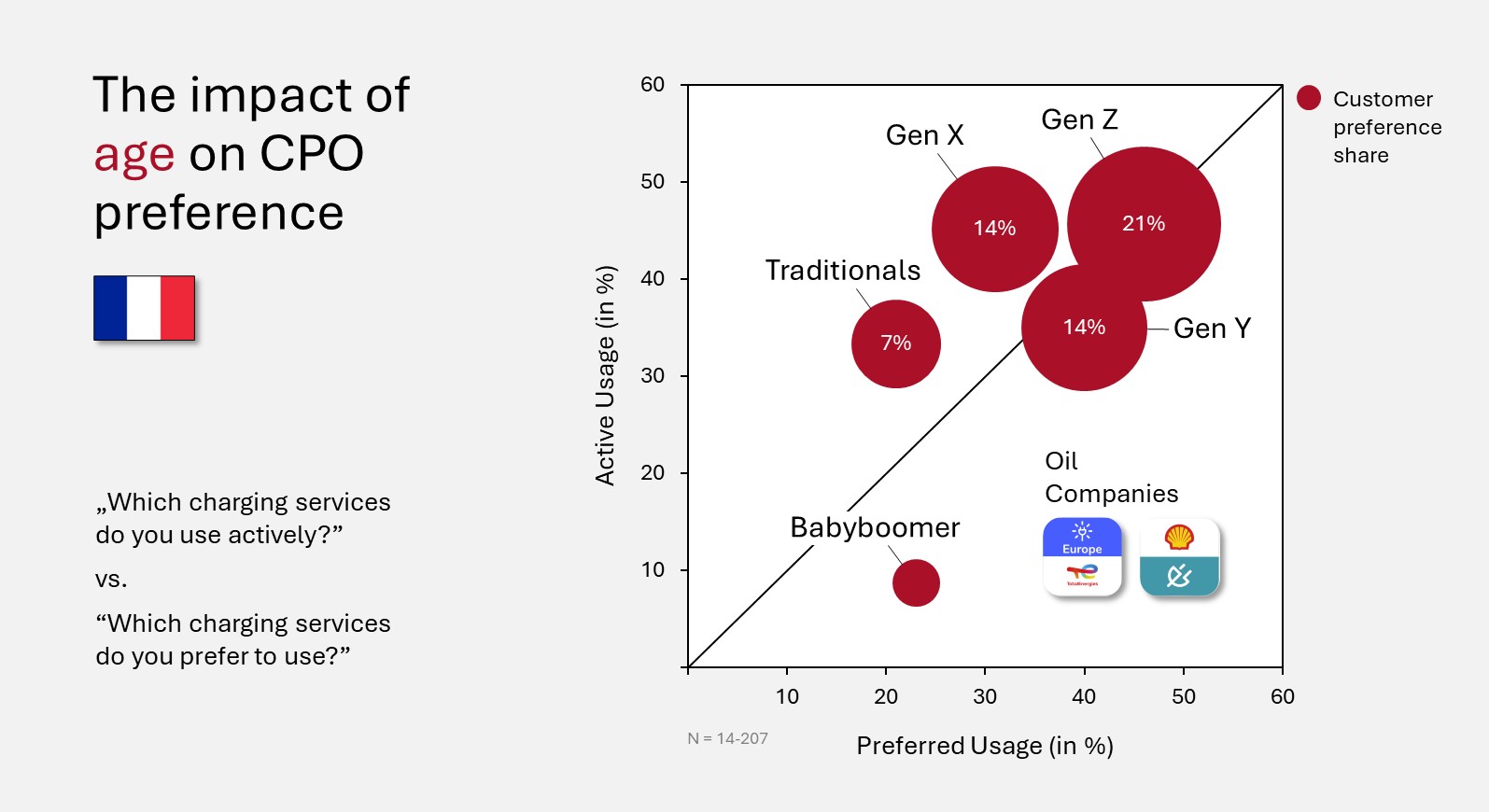
The changing market structures are exemplified and at the same time clearly illustrated by the influence of age on the performance of oil companies. While only 2% of baby boomers prefer these providers, the share reaches an impressive 21% among Gen Z. The younger the EV drivers, the more strongly they prefer well‑known brands from oil companies, a relationship that can be leveraged for targeted marketing strategies.
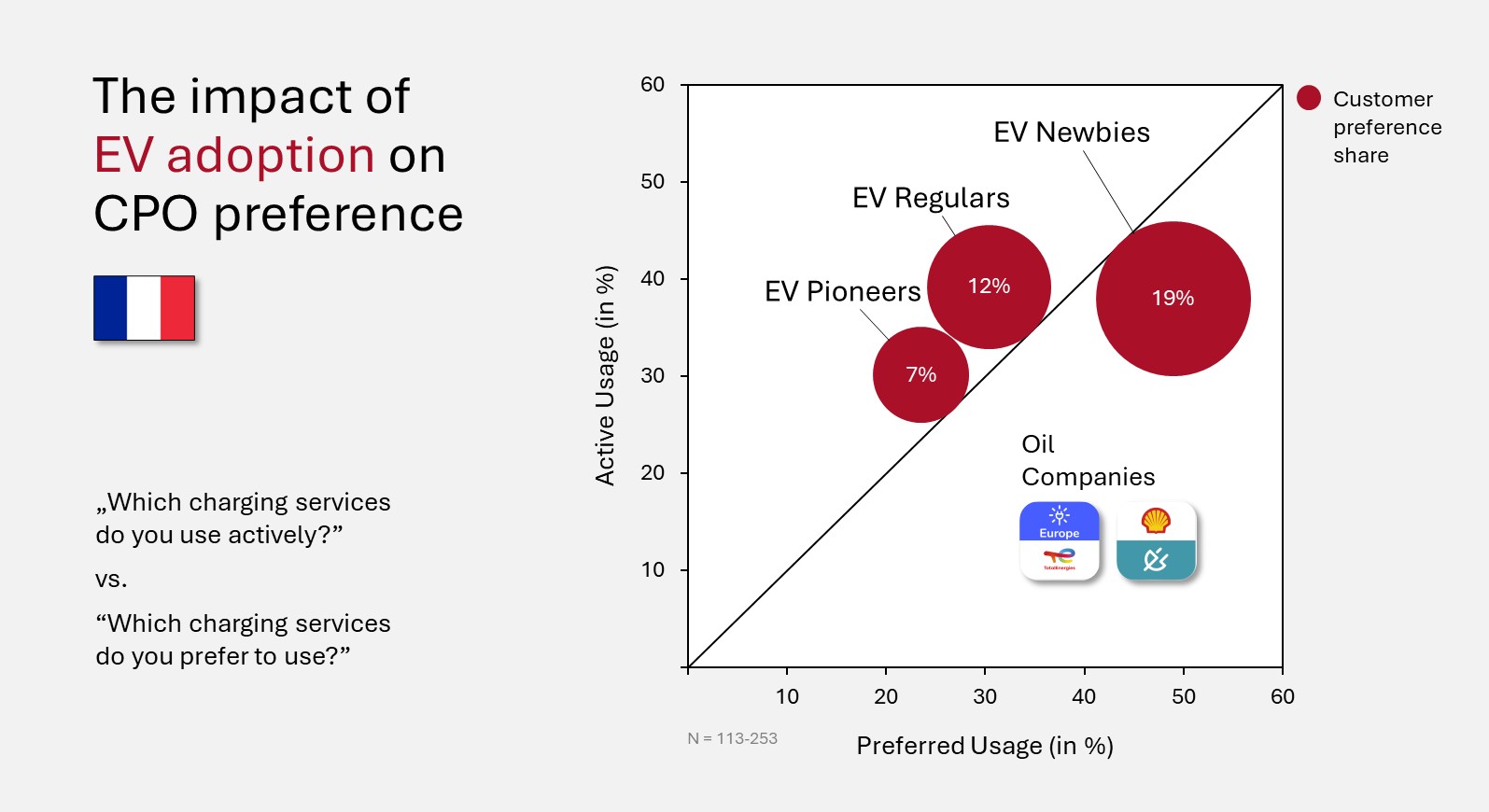
The impact of EV experience is also striking: among “young” EV adopters (less than 2 years driving electric), Big Oil achieves a customer preference share of 19%. Among drivers with 2 to 3 years of experience this share drops to 12%, while long‑term EV users (more than 3 years) allocate only 7% to Big Oil. Newcomers are therefore more open to established brands. This trend benefits oil companies during the ramp‑up of e‑mobility and can be leveraged for targeted onboarding strategies.
An interesting detail: among newcomers, the Preferred Use share rises significantly. Preference thus increases notably, while the share of active usage remains stagnant. For oil brands, the greatest potential therefore lies in marketing to new customers.
What matters here:
With every new customer segment entering electromobility, the market shifts. This is especially true in a dynamic environment such as France, where infrastructure, the provider landscape, and the political framework are evolving rapidly.
The CPO / eMSP Charging Services Study 2025
The USCALE Charging Services Study 2025 reveals the strengths, weaknesses, and opportunities of different providers—from market shares and the impact of service features and charging prices on take‑rate right through to brand perception. For CPOs and eMSPs, the study provides an essential foundation for reviewing and realigning their strategic positioning and securing competitive advantages.
Whoever engages with the right questions now will be well prepared for the next phase of the market:
- How do I differentiate myself beyond price?
- Which target groups do I address – and how?
- How do I strengthen my brand in an increasingly saturated market?
- How do I increase the utilization of my charging points?
One thing is clear:
EV charging is at the threshold of moving from an infrastructure‑driven to a customer‑driven market.
Your benefit from the study
The USCALE CPO/eMSP Charging Services Study for France shows you
- where your brand stands on the demand side,
- how high your customer preference share is in relevant customer segments, and
- what untapped potential exists in markets and target groups.
If you would like to understand how the French charging market works, why EV drivers in France charge exactly where they do today, and how you can systematically shift Active Use, Preferred Use, and loyalty in your favor, please get in touch with us.
Feel free to also take a look at the overview of our multi‑client charging studies!
Contact us now
Which customer insights on electric cars, charging technology, or charging services are you looking for? Whatever you’re searching for, we look forward to exchanging ideas with you.
* mandatory